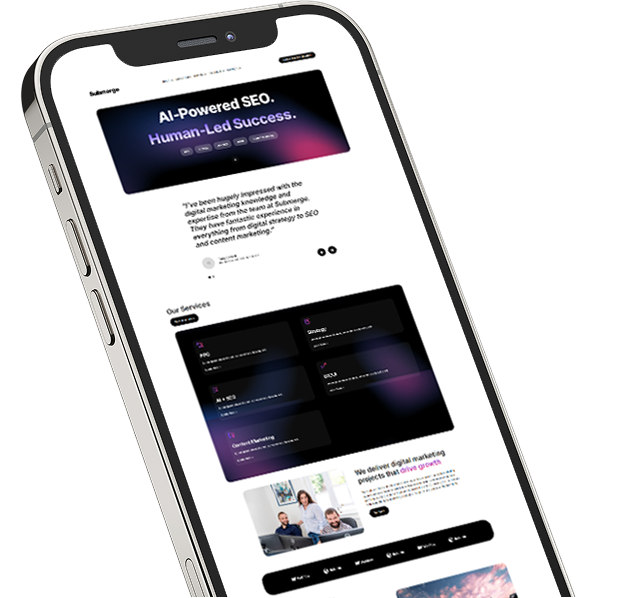
Digital marketingand visibility strategy
Be visible. Everywhere your customers are.
Stop guessing where to find customers. Our strategic insights are built on decades of real-world, hands-on, technical and strategic expertise across a wide range of sectors. From FTSE250 companies to charities and government organisations, we provide strategic insights into where customers are, how they search, their journey to and through your world, and how to grow your brand within the market.

Discover our
marketing strategy expertise
Strategy creates clarity.
Marketing becomes significantly more effective when decisions are based on evidence rather than assumptions. Our strategic consultancy combines audience insight, market intelligence, search data, competitive analysis and performance measurement to help organisations make more informed decisions about where to invest, how to grow and which opportunities matter most.
From visibility and discoverability to channel planning, AI strategy and growth forecasting, we help leadership teams build practical digital marketing strategies aligned with measurable business outcomes.

SEMrush Agency Partner
We’re a fully Certified SEMrush Agency Partner – we provide detailed data analysis and insights based on enterprise-level search data.
WP Engine Agency Partner
We’re a Certified WP Engine Agency Partner – our strategic approach is built on solid, hard-won platform experience spanning decades.

Cyber Essentials Certified
We’re Cyber Essentials Certified – Security-conscious technical delivery aligned with recognised UK cybersecurity standards.






Trusted by brands including









Build visibility where customers discover brands.
Search engines are no longer the sole gateway to attention. Customers now discover organisations through AI-generated answers, social platforms, media coverage, communities, recommendations and traditional search journeys.
Our visibility strategies help organisations understand how discoverable they are today, where opportunities exist and how visibility is created across modern digital ecosystems. We combine search intelligence, AI discoverability, audience behaviour and competitive analysis to build clear strategic roadmaps for growth.
Understand the market before your competitors.
Markets evolve continuously. Search behaviour changes. New competitors emerge. AI platforms reshape discovery. Audience priorities shift.
We help organisations develop a clearer understanding of their competitive environment through market intelligence, search analysis, visibility benchmarking and audience research. This creates a stronger foundation for strategic decision-making, investment prioritisation and long-term growth planning.


Reach the right audiences through the right channels.
Not every audience behaves in the same way. Different customer groups discover, evaluate and engage with brands through different combinations of search, social, media, communities, email and AI-powered platforms.
We help organisations understand how customers move through modern digital journeys and develop channel strategies that align with real-world behaviour. The result is more effective marketing investment, stronger engagement and clearer acquisition pathways.
Prepare for the future of discoverability.
Search is evolving rapidly. Traditional rankings now sit alongside AI-generated answers, recommendation systems and machine-driven discovery experiences.
Our search and AI strategies help organisations understand how visibility is changing and how to adapt. We combine technical expertise, search intelligence, authority-building and AI discoverability planning to help businesses remain visible as search ecosystems evolve.


Align channels, teams and goals around growth.
Many organisations have campaigns, content and channels in place, but lack a coherent framework connecting activity to commercial outcomes.
We develop detailed digital marketing strategies that bring together audience insight, acquisition planning, content, reporting, KPIs, operational considerations and growth forecasting. The result is a practical strategy that supports both leadership decision-making and day-to-day execution.
Turn search behaviour into strategic insight.
Search data provides one of the clearest views into customer intent available anywhere.
We analyse search demand, topic trends, audience interests, competitor movement, AI visibility and emerging opportunities to understand how markets are changing. This intelligence helps organisations identify new growth areas, prioritise content investment, improve acquisition strategy and spot opportunities before competitors do.

Strategic success stories

Opportunity Green
Learn how Submerge redesigned and developed Opportunity Green's new WordPress website to support tackling climate change.

Bill Wyman
Explore our web design and content marketing work with Bill Wyman, former bass player with the Rolling Stones. Full site design and build.

Ascentor
Discover our work with Ascentor. Learn how our web development delivered impressive results, driving Ascentor's online growth and success.

Orion Registrar, Inc.
Read our web development and migration case study detailing how Submerge transformed Orion Registrar's website with a focus on SEO.

ISO 9001
Building global search visibility for a certification leader – 312% organic traffic growth and 400% CTR boost in six months.

Laithwaites
Learn how Submerge worked with Laithwaites UK team boosting SEO, content strategy, and performance monitoring for success.
Start your visibility project with us
Get a FREE strategy consultation!
Get a free, no-obligation audit from Submerge – Hertfordshire’s leading digital marketing agency
Say hello to Submerge

Matthew Bath

Lynn Wright

Marc Bodger

Aimee Lashko-Sayers

Lara Palamoudian

Nicole Percival

Jesse Hopkins
Fancy a marketing strategy chat with Matt?Book a FREE Google Meet!
Discover our latest guides, advice and insights
for digital marketing strategies.

0 Comments22 Minutes
SEO copywriting checklist for in-house editors
Improve your in-house content with a practical SEO copywriting checklist that improves clarity, search visibility and…

0 Comments17 Minutes
Your guide to the new Google search bar in 2026
Google underwent a major update to keep up with changing search behaviour. Learn how this could impact your business and…

0 Comments17 Minutes
What Google’s new AI version of search means for your business’s visibility
Google Search is changing to better fit its users' changing needs and expectations. Learn how this change will impact your…
Marketing strategy FAQs.
Artificial intelligence is changing far more than content creation and productivity. It is fundamentally altering how customers discover information, evaluate options and make decisions.
For the last twenty years, most digital strategies assumed that search engines acted as the primary gateway to information. Customers searched, reviewed results, clicked websites and moved through relatively predictable digital journeys. AI-powered platforms such as ChatGPT, Google AI Overviews, Perplexity and Copilot are disrupting that model by increasingly acting as intermediaries between businesses and audiences.
This creates a new strategic challenge for organisations. Visibility is no longer determined solely by rankings, advertising spend or content production. Businesses now need to consider how they are represented within AI-generated responses, which sources and authority signals influence AI systems, and how discoverability changes when users receive answers rather than lists of links.
For leadership teams, AI should therefore be viewed as a strategic shift rather than simply a marketing trend. Organisations that adapt early can strengthen discoverability, improve operational efficiency and identify new opportunities for growth. Those that ignore the change risk becoming progressively less visible as customer behaviour continues to evolve.
Effective digital marketing strategies start with understanding the business rather than the channels.
Many organisations begin by discussing SEO, social media, PPC or content marketing. In reality, these are simply delivery mechanisms. Before channels are considered, it is important to understand commercial objectives, market conditions, competitive pressures, audience behaviour and the operational realities of the organisation itself.
The next step is developing a clear understanding of how customers discover, evaluate and engage with the business. This often involves audience research, search analysis, competitor benchmarking, journey mapping and performance reviews across existing channels. These activities help identify opportunities, weaknesses and areas where investment is likely to generate the greatest return.
Only then should channel strategy, content planning, measurement frameworks and implementation roadmaps be developed. The most effective strategies align marketing activity with business goals, operational capability and measurable outcomes. They provide a framework for decision-making rather than simply a list of marketing tactics.
A good strategy should help answer three questions:
- Where are we today?
- Where do we want to get to?
- What is the most effective route to get there?
A marketing strategy should provide a clear framework for how an organisation creates visibility, generates demand and achieves commercial growth.
At a minimum, this should include an assessment of the current situation, including market conditions, competitive positioning, audience behaviour and existing marketing performance. Without understanding the starting point, it is difficult to prioritise investment or identify meaningful opportunities.
The strategy should also define target audiences, key customer journeys, messaging frameworks, channel priorities and measurable objectives. Increasingly, organisations also need to consider AI discoverability, search ecosystems, content authority and the role of digital visibility beyond traditional channels.
Importantly, a strategy should not focus solely on external activity. Internal factors often play an equally significant role in success. Team structures, reporting frameworks, operational processes, budget constraints and measurement capabilities all influence whether a strategy can be executed effectively.
The strongest strategies combine commercial ambition with operational reality, ensuring that recommendations are both strategically sound and practically deliverable.
Growth opportunities rarely appear by accident. They are usually uncovered through structured analysis of demand, competition, audience behaviour and market movement.
Search data is often one of the most valuable sources of intelligence available. It reveals what people are actively interested in, how demand changes over time and where emerging opportunities may be developing. Search behaviour frequently highlights shifts in customer priorities months before they become obvious through sales or industry reporting.
Competitor analysis provides another important perspective. Understanding how competitors acquire customers, build authority, position themselves and invest in different channels often reveals opportunities that are hidden in plain sight. Sometimes the greatest opportunity is not attacking a competitor’s strength, but identifying where they are absent, weak or failing to meet audience needs.
Growth analysis should also consider wider market factors such as technological change, AI adoption, regulatory developments, customer expectations and channel evolution. Organisations that combine market intelligence, search insight and customer understanding are typically better positioned to identify opportunities before competitors react.
One of the most common mistakes organisations make is confusing activity with progress.
Publishing content, running campaigns or increasing social engagement may indicate that activity is taking place, but these metrics alone do not demonstrate strategic success. Effective measurement begins by defining what success actually looks like and then building reporting frameworks around those outcomes.
The most useful KPIs vary between organisations, but they often include measures such as visibility growth, share of search, lead generation, conversion performance, customer acquisition, revenue contribution and broader indicators of market position. Increasingly, organisations are also beginning to track AI discoverability, citation visibility and authority signals alongside more traditional marketing metrics.
Measurement should be viewed as an ongoing process rather than a monthly reporting exercise. Markets evolve, customer behaviour changes and channels mature over time. A successful strategy is one that creates measurable progress towards business goals while remaining adaptable enough to respond to new opportunities and challenges.
Ultimately, the purpose of measurement is not simply to report performance. It is to improve decision-making. The best reporting frameworks help organisations understand what is working, what is not and where the next opportunity for growth is likely to come from.
Learn more about our attribution and measurement services.
If you’re not visible
nothing else matters.
Let’s understand where you stand today – and where the opportunities are.
Get in touch and let’s chat about your project.