Earlier this month, Google rolled out the “biggest upgrade to our Search box in over 25 years.”
While all the headlines have been about the new search bar – dubbed the “Intelligent Search Box” – the real story is much bigger than a simple visual redesign.
Search is becoming more conversational, more visual, and more powered by AI. Instead of simply typing in a few keywords and getting a page of blue links to scroll through, users are being encouraged to almost “talk” to search engines by asking fuller questions, following up naturally, and (in some cases) letting Google do more of the searching for them.
For businesses, this matters – a lot.
If your target customers use Google to find products, services, and answers, the way your business shows up (or doesn’t) is changing. This update has implications for almost every effort that impacts online visibility, including content, SEO strategy, and professional presence.
What has changed in Google Search?
People are talking about a “new Google search bar”, but that’s really shorthand for a much broader update on how Search works.
Google is redesigning Search so it can handle longer, more natural questions and give users more AI-generated help before they ever click through to a website.
You could think of Google now acting more like an assistant than a search engine – it’s trying to give you what you want before you ask for it.
Here’s a rundown of the changes:
| What’s changed | What it means in practice |
|---|---|
| An expanding search bar | Users are encouraged to input full questions instead of short keyword phrases, the box expanding as you type |
| AI Mode | Google can provide more detailed, AI-generated answers and support follow-up questions |
| AI Overviews | Some searches now show a summary answer at the top of results before standard website links |
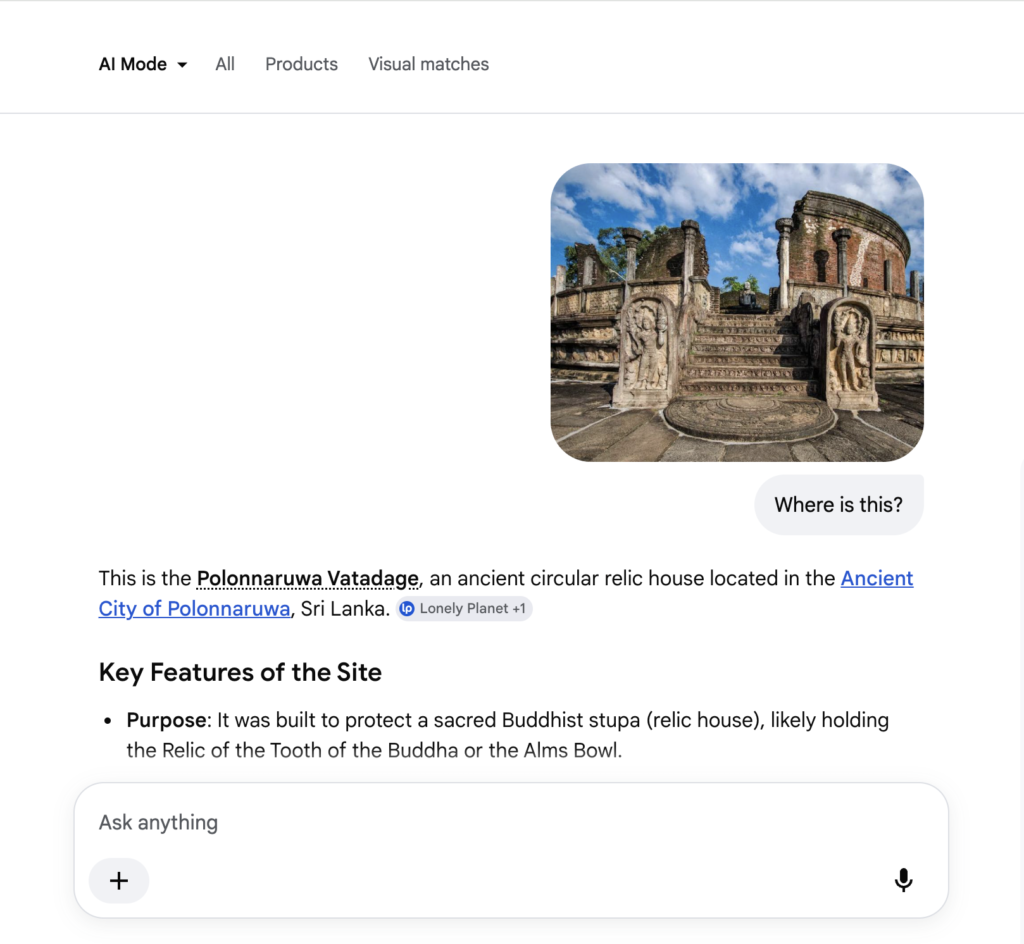
| Multimodal search | You can search with text, voice, images, and live camera input |
| Deeper task support | Google is starting to help with more action-based searches, such as comparing options or assisting with bookings and purchases |
| More personalised results | In some cases, Google can use context from previous searches or connected tools to make results more tailored to you |
| Interactive results | Search is becoming more visual and dynamic, including charts, product information, and richer result formats |
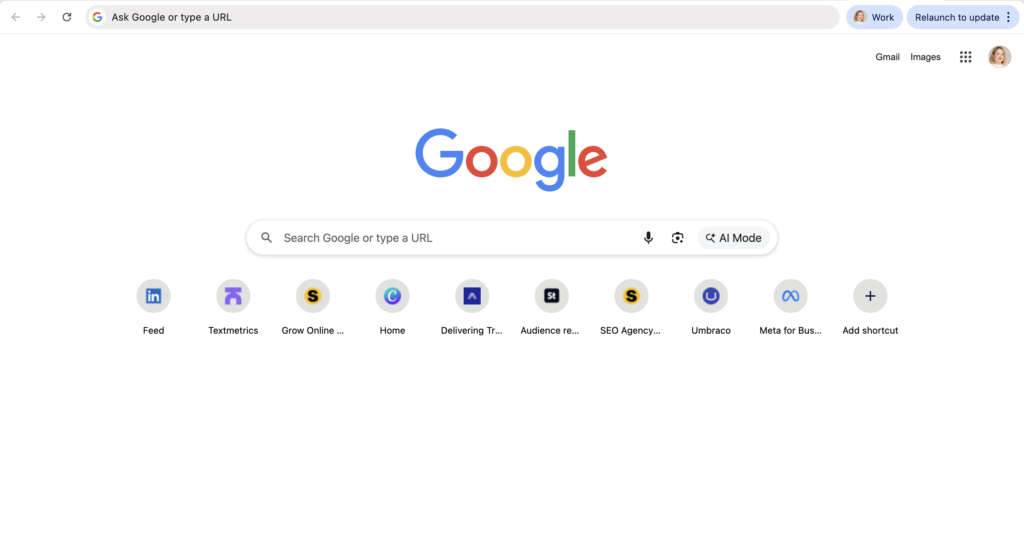
Google search used to look like this:
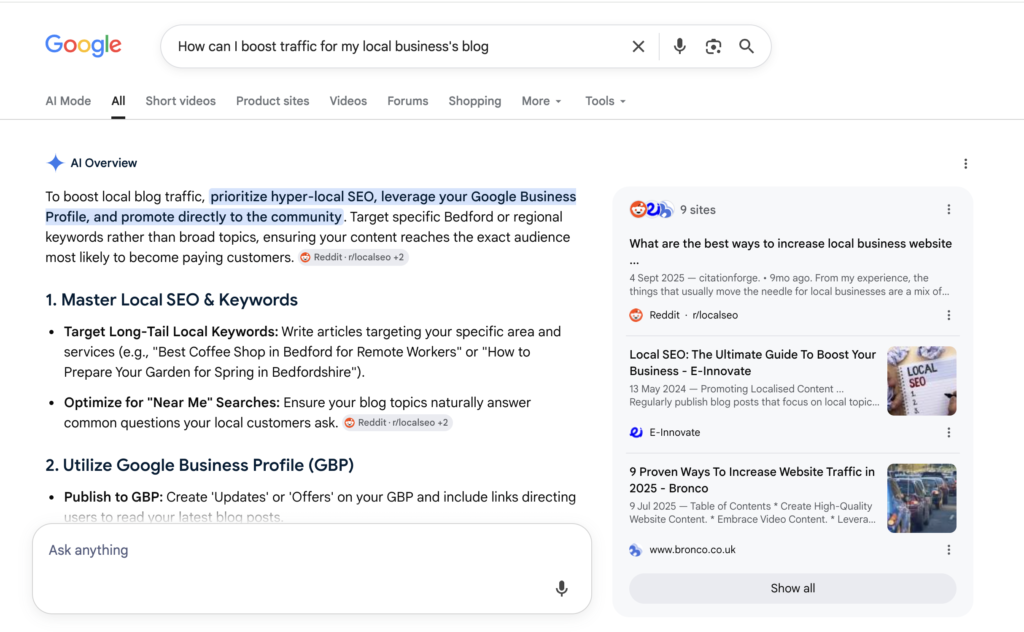
But now, it looks like this:
And you can even use it like this:
It’s important to note that the new Intelligent Search Box and AI Mode aren’t replacing the SERPs we’ve recognised and optimised for years – you just need to scroll down to find them.
Learn more about Submerge’s AI &LLM visibility services.
So, is it just the search bar that changed?
Not really. The search bar is the visible symbol of the update, but the bigger shift is that Google wants people to search in a more natural, chat-like way.
For example, a business in need of PR services historically could have searched for “PR agencies Hertfordshire”, but Google’s update is now pushing them to be more specific, searching for “PR agencies in Hertfordshire with experience in the wine industry to compare”.
The difference is subtle enough, but it changes how Google interprets searches and how businesses make themselves more visible online.
The new Google Search is also powered by Google Gemini 3.5 Flash, the latest Gemini release.
Why has Google made this change?
There are two main reasons for this big change: changing user expectations and increased competition in the search industry.
Changing user expectations
Tools like ChatGPT and Gemini becoming easily accessible have changed how people expect to find information online.
Rather than scrolling through pages of blue links and piecing together information from multiple webpages, users are preferring the convenience of typing their query into AI tools and getting a useful answer within seconds.
Google is aware of this, so instead of forcing users to leave Search for AI tools, it’s building more AI directly into Search itself.
Even so, it’s unlikely Google Search would be entirely abandoned by users for AI tools, especially since it receives 143x more traffic than ChatGPT does.
Increased competition
People are already searching in more complex ways, across more devices, and often with less patience.
The customer journey is also more disrupted and tangled now there are new tools and more availability. It’s rare for customers to simply search for a specific branded item, add it to their basket, and checkout immediately.
Instead, they’ll do general research, pinpoint certain brands, research those brands, have their search interrupted before they return another day on a different device, find specific products, add to cart, then abandon cart, use AI to compare specific products, use another device with the intent to purchase, only to do a final round of research and comparison before entering their card details.
Google is aiming to be more convenient and convincing to searchers, providing them with all the information and support they need to take the desired action much sooner rather than later.
Discover our audience and channel strategy services.
What is Google trying to achieve?
Google’s aim is to keep Search useful in a world where users expect faster, smarter answers.
In practical terms, that means:
- Reducing the effort needed to find information
- Helping users ask more complicated questions
- Making search feel more like a conversation
- Handling more of the comparison and research process inside Google
- Keeping people within the Google ecosystem for longer
That last point is key for businesses.
If Google answers more questions directly on the results page, some users may be less likely to click through to websites. So while visibility in Google remains essential, the nature of that visibility is changing.
What does this mean for my business?
This update matters because it changes how customers discover and evaluate businesses online.
If your business generates a lot of traffic or leads through its blogs or downloadable, it’s understandable if you’re feeling like this new update an AI Overviews in general could threaten that.
Some of the biggest implications of this update include…
Reprioritising rankings
For years, many SEO strategies focused heavily on winning one of the top blue-link positions. In theory, ranking first would mean more traffic, which would then translate into more business.
Your ranking position in SERPs still matters, even with this update, but now businesses may also need to appear in:
- AI Overviews
- Featured snippets
- Maps results
- Image-based search results
- Product and shopping experiences
A user may read an AI-generated summary before they ever see your website listling. If your business isn’t part of the content Google draws on, you may lose visibility even if your site still ranks reasonably well.
Learn more about how to appear in featured snippets.
Adjusting content angles for maximum value
Google’s newer search experience favours content that clearly answers real questions.
That means businesses should focus less on awkward keyword stuffing and more on creating genuinely useful material such as:
- Detailed service pages
- FAQs
- Comparison guides
- Explainers
- Pricing information
- Case studies
- Trust-building content
Businesses that explain things clearly are more likely to be found by AI tools. If your website only says what you do in broad marketing language, it may be easier for competitors with more useful content to become the source Google uses in AI-driven results.
Ready to get started? Read our top tips for optimising content for AI search.
Longer, less linear search journeys
Like we said previously, it’s rare for shoppers to search once, click once, and buy immediately.
With so much information out there and so many tools available to make it easier to sift through, search behaviour has shifted and so has the path most online journeys take. Searchers don’t just type and purchase anymore – they ask, compare, check, compare more, and ask more before they even click “add to cart”.
This means businesses need content that supports multiple stages of decision-making, not just the final “buy now” stage.
For example, a potential customer may not begin with “marketing agency Manchester”, but instead “Why is my website traffic dropping?” and then follow up with “What should a digital agency audit include?” Only after that could they search for marketing agencies.
If your business only targets bottom-of-funnel keywords, you may miss earlier visibility opportunities.
Building brand trust will be more important
As search becomes more AI-led, Google still needs signals it can trust. This involves customer reviews, well-structured content with quality backlinks, consistency across platforms, and accurate business information.
Businesses with weak, thin, outdated, or confusing websites may struggle more in this new environment.
If Google is trying to summarise the best answers for users, it is more likely to pull from businesses that look credible and complete.
Still focusing on local search
For businesses serving specific regions or local markets, this update does not reduce the importance of local SEO – it increases it.
Google remains a major starting point for people looking for local businesses, and many searches now happen on mobile devices, often with immediate intent.
That means businesses should pay close attention to their Google My Business profile, making sure to include details such as opening times, contact information, addresses, reviews, and map visibility.
If a user asks Google for the “best” or “nearest” solution, Google needs strong local signals to know whether your business is relevant.
Prioritising quality to maximise link clicks
One of the challenges with AI-generated search experiences is that users may get enough information without clicking through – nearly 60% of Google Searches now end in zero clicks.
That does not mean SEO is dead, but it does mean businesses may need to think beyond traffic volume alone.
More useful questions to ask your business include:
- Are we appearing in the right searches?
- Are we being mentioned or cited in Google’s AI summaries?
- Are we attracting qualified visitors?
- Does our content build enough trust to earn the click when it matters?
In this environment, a smaller number of better-qualified visits may be more valuable than high traffic from vague searches.
This may seem like a lot to consider, especially if you’re looking to keep your business’s online numbers up, but we encourage all our clients to view updates like these as an opportunity to improve and move forward with a clearer understanding of what their target audience want.
Read our guide to the best AI tools for SEO in 2026.
What should my business do now online?
The businesses that respond well to Google’s update will be the ones that actively improve their clarity, usefulness, and trust online.
Here are a few practical steps your business could take to give it the bet chance of surviving.
- Review your website content: Make sure your website answers the questions your customers are actually asking. Clear, helpful, plain-English content is far more valuable now than vague marketing copy or pages written mainly for search engines.
- Create content around real customer intent: Think beyond keywords and focus on what people want to know before they buy, such as pricing, process, comparisons, timelines, and common concerns. This is the kind of content Google is increasingly rewarding.
- Strengthen your local presence: If you serve a local area, keep your Google Business Profile accurate and active. Local visibility still plays a major role in how customers discover businesses, especially on mobile and “near me” searches.
- Make your site easier to understand: A well-structured website helps both users and Google. Clear headings, simple navigation, mobile-friendly design, and fast-loading pages all improve your chances of being surfaced in search.
- Measure visibility, not just rankings: Being on page one is no longer the full picture. Businesses should also watch how they appear in AI summaries, local results, and other search features that influence whether people notice and trust them.
Google’s update is a sign of where search is going, not just a one-off interface change.
Search is more conversational and more direct than ever. For users, that makes the experience more useful and rewarding, but for businesses? It means online visibility is becoming more competitive and more nuanced. Being present in search now depends not only on technical SEO, but on whether your business provides the kind of clear, useful, trustworthy information Google wants to surface.
The businesses that will benefit most from this update are not necessarily the ones chasing every new trend. They are the ones that:
- Understand what their customers are asking
- Create content that answers those questions clearly
- Maintain a strong, credible online presence
- Adapt early as search behaviour evolves
If you’re ready to make these changes, but aren’t sure where to begin, why not book a free consultation with us?

Related Digital Marketing Resources

0 Comments19 Minutes
How to upskill your in-house content team for SEO and AI search
Want to upskill your content team? Explore how to prioritise training and improve the quality and consistency of your content.

0 Comments20 Minutes
Why your web team needs a bigger role in search visibility strategy
Discover why web teams play a vital role in search visibility and how website design, technical performance and structure can support SEO and AI search.
0 Comments13 Minutes
Ethics in AI: How to use AI tools responsibly as a business
Discover why ethics in AI matters and how to make the most of new tools while managing risks and maintaining quality.
If you’re not visible
nothing else matters.
Let’s understand where you stand today — and where the opportunities are.
Get in touch and let’s chat about your project.