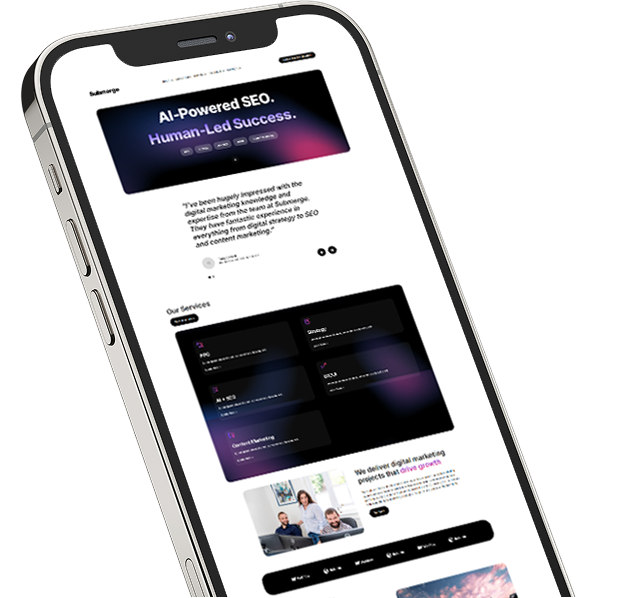
Marketing dashboardsand reporting
Clear reporting. Better decisions.
Most businesses already have access to huge volumes of data. The challenge is turning that data into reporting that stakeholders can actually use. We build bespoke marketing dashboards and reporting frameworks that help teams understand performance, track KPIs and make better marketing and commercial decisions.

Bespoke, actionable marketing
dashboards and reports
Good reporting should create clarity, not noise.
Many businesses already have dashboards.
What they often lack is useful reporting.
Marketing teams are frequently working across disconnected platforms, inconsistent KPIs and fragmented reporting structures. GA4, Search Console, Google Ads, Meta, CRM systems, SEO tools and spreadsheets may all report different versions of performance. Senior stakeholders then struggle to understand what is actually happening – or which metrics matter most.
Submerge helps businesses build reporting systems designed around decision-making.
We create bespoke marketing dashboards that connect marketing, search, analytics and commercial data into clear, accessible reporting frameworks tailored to the needs of different stakeholders across the business.
Strong reporting is not about displaying more charts.
It is about helping teams understand:
- how channels are performing
- where growth is happening
- which campaigns are driving value
- how users move through journeys
- where targets are being missed
- and what should happen next.
The best dashboards become operational tools – not static reports that sit unread after meetings.

SEMrush Agency Partner
We’re a fully Certified SEMrush Agency Partner – we build interactive, actionable dashboards connecting Google, Meta, HubSpot, social, email and digital marketing APIs.
WP Engine Agency Partner
We’re a Certified WP Engine Agency Partner – we build and integrate effective tracking and monitoring in WordPress website, so you know what’s what.

Cyber Essentials Certified
We’re Cyber Essentials Certified – Security-conscious technical delivery aligned with recognised UK cybersecurity standards.







Trusted by brands including









Dashboards and reporting expertise
Dashboard development
Most off-the-shelf dashboards are either too generic or too complex.
We build bespoke dashboards tailored around how businesses actually measure success. This includes integrating analytics, SEO, paid media, ecommerce, CRM and campaign data into reporting views designed around KPIs, performance trends and commercial objectives.
Dashboards are structured differently depending on audience and use case. Marketing managers may need channel-level visibility and campaign diagnostics, while leadership teams often require higher-level performance summaries focused on growth, ROI and strategic trends.
Our dashboards are designed to be interactive, accessible and genuinely useful across the organisation.
Bespoke dashboard builds
Interactive reporting environments
API-connected data integration
Stakeholder-specific reporting views

KPI reporting
Many businesses track metrics without clearly defining which KPIs actually matter.
Traffic, impressions and engagement may all be useful indicators, but effective KPI reporting connects activity to outcomes. We help businesses define and structure KPI frameworks aligned with marketing goals, commercial objectives and operational reporting requirements.
This can include ecommerce revenue, ROAS, conversion rate, lead quality, customer acquisition, assisted conversions, organic visibility, engagement metrics, campaign efficiency, audience growth and customer value metrics.
Strong KPI reporting helps teams stay aligned around measurable goals while reducing reporting noise and metric overload.
KPI framework development
Commercial performance reporting
Marketing & revenue alignment
Goal and target tracking

Cross-channel reporting
Modern marketing performance rarely exists within a single platform.
SEO, paid media, content marketing, social campaigns, CRM systems and analytics tools all contribute to broader commercial performance. Without integrated reporting, teams often struggle to understand how channels interact or influence customer journeys over time.
We create cross-channel dashboards that connect data sources into a unified reporting environment. Using platforms such as Looker Studio, AgencyAnalytics, SEOcrawl, GA4, Search Console and SEMrush, we help businesses track performance holistically rather than in isolated silos.
This gives teams greater visibility into acquisition pathways, campaign interaction, assisted performance, audience behaviour, conversion journeys and long-term visibility trends.
Multi-platform reporting integration
SEO & paid media reporting
Campaign performance tracking
Journey & channel analysis

Realtime performance visibility
Static monthly reports often arrive too late to support meaningful optimisation.
Realtime dashboards allow businesses to monitor performance continuously, identify trends earlier and respond more quickly to changes across channels, campaigns and user behaviour.
We build reporting systems that surface meaningful performance signals in accessible ways. This may include realtime campaign monitoring, organic visibility tracking, ecommerce performance, lead flow reporting, conversion trends and technical SEO diagnostics.
Strong realtime reporting helps businesses move from reactive reporting cycles to more agile, data-informed decision-making.
Realtime KPI monitoring
Trend & anomaly tracking
Live campaign visibility
Ongoing performance analysis


Reporting is becoming more operational.
Marketing dashboards are no longer just tools for monthly reporting meetings.
Marketing teams require real-time reporting to monitor performance, spot changes early and support ongoing optimisation across channels and campaigns. At the same time, AI-powered discovery and more fragmented customer journeys are making measurement more complex. This means reporting must become clearer, more integrated and more commercially focused. The businesses gaining the most value from data are often not those with the most dashboards, but those with the clearest measurement frameworks and most actionable reporting.
Start with an reporting & dashboard review
Understand whether your current reporting setup gives stakeholders the clarity they actually need.
We assess dashboard structures, KPI alignment, reporting usability, cross-channel visibility, API integrations, realtime reporting capability, stakeholder requirements and performance tracking frameworks.
Visibility success stories

Opportunity Green
Learn how Submerge redesigned and developed Opportunity Green's new WordPress website to support tackling climate change.
Bill Wyman
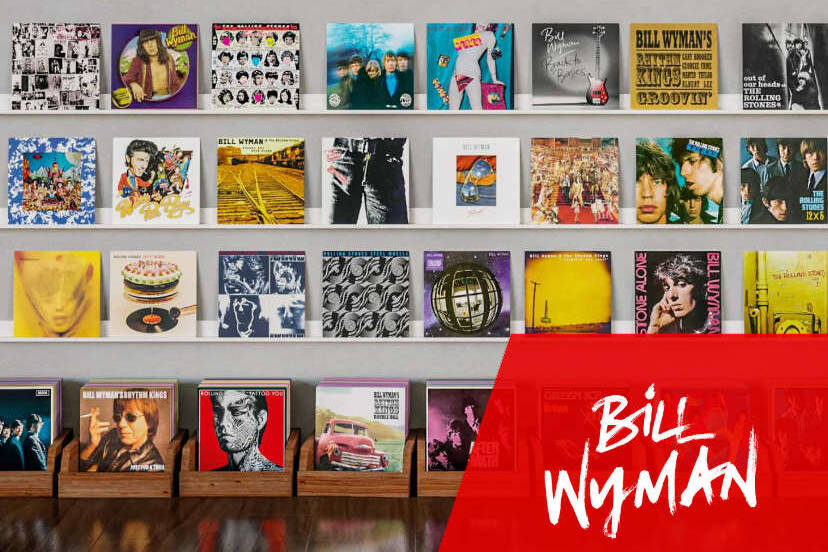
Explore our web design and content marketing work with Bill Wyman, former bass player with the Rolling Stones. Full site design and build.

Ascentor
Discover our work with Ascentor. Learn how our web development delivered impressive results, driving Ascentor's online growth and success.

Orion Registrar, Inc.
Read our web development and migration case study detailing how Submerge transformed Orion Registrar's website with a focus on SEO.

ISO 9001
Building global search visibility for a certification leader – 312% organic traffic growth and 400% CTR boost in six months.

Laithwaites
Learn how Submerge worked with Laithwaites UK team boosting SEO, content strategy, and performance monitoring for success.
The best dashboards help teams make faster, better decisions.
Reporting should not overwhelm teams with endless metrics and disconnected charts. Strong dashboards surface the KPIs, trends and performance signals that actually influence marketing, commercial and strategic decision-making.
Modern reporting environments increasingly need to combine technical visibility, channel performance, customer journeys and commercial outcomes into one accessible view. Businesses that build clearer reporting frameworks are often better positioned to optimise faster and align teams around measurable goals.
40%
Of marketers consider lead quality as their most important reporting metric.
230%
How much more data marketers have compared to 2020.
60%
Of marketers say they don’t have enough to analyse data.
14%
Of marketers say low data expertise holds their team back.
Source: Supermetrics, HubSpot
“Throughout the entire process, they kept us updated with regular progress reports and were always available to answer any questions. Submerge is our go-to company for all our digital marketing needs.”
Andy Evangelou
Owner, AKE Accountancy
Say hello to Submerge

Matthew Bath

Lynn Wright

Marc Bodger

Aimee Lashko-Sayers

Lara Palamoudian

Nicole Percival

Jesse Hopkins
Reporting expertise built around performance clarityBook a consultation
Discover our latest guides, advice and insights
for marketing performance analysis

0 Comments22 Minutes
SEO copywriting checklist for in-house editors
Improve your in-house content with a practical SEO copywriting checklist that improves clarity, search visibility and…

0 Comments17 Minutes
Your guide to the new Google search bar in 2026
Google underwent a major update to keep up with changing search behaviour. Learn how this could impact your business and…

0 Comments17 Minutes
What Google’s new AI version of search means for your business’s visibility
Google Search is changing to better fit its users' changing needs and expectations. Learn how this change will impact your…
Dashboard and reporting FAQs
A good marketing dashboard provides clear, actionable visibility into performance rather than simply displaying large volumes of data.
Effective dashboards are built around the needs of the people using them. Marketing managers may require detailed channel diagnostics and campaign tracking, while directors and leadership teams often need higher-level KPI reporting focused on growth, ROI and commercial performance. The structure, granularity and visualisation of data should reflect how decisions are actually made within the business.
Strong dashboards also prioritise usability. The most effective reporting environments help teams quickly identify trends, performance changes, risks and opportunities without requiring users to manually interpret multiple disconnected reports.
Related expertise:
- Dashboard development
- KPI reporting
- Executive reporting frameworks
The right KPIs depend on the organisation’s goals, channels and commercial model.
For ecommerce businesses, important KPIs may include revenue, ROAS, average order value, conversion rate, cart abandonment, customer acquisition cost and customer lifetime value. Lead generation businesses may focus more heavily on enquiry volume, lead quality, conversion pathways, assisted conversions and pipeline contribution.
The key is ensuring KPIs connect marketing activity to measurable outcomes. Vanity metrics alone rarely provide enough commercial insight. Strong KPI frameworks balance visibility, engagement and commercial performance to create a more meaningful view of success.
Related expertise:
- KPI framework development
- Revenue reporting
- Attribution & measurement
Modern reporting dashboards often combine multiple data sources and platforms.
At Submerge, we commonly work with:
- GA4
- Google Search Console
- Data Studio (formerly Looker Studio)
- AgencyAnalytics
- SEOcrawl
- SEMrush
- Google Ads
- Meta reporting
- CRM integrations
- ecommerce platforms
APIs and integrations allow these systems to feed into centralised reporting environments, creating clearer visibility across marketing, search, commercial and customer performance.
Related expertise:
- API-connected dashboards
- Cross-channel reporting
- Integrated marketing reporting
Many businesses collect large amounts of data without a clear reporting structure.
Different platforms often report performance differently, teams may use inconsistent KPIs and dashboards may evolve over time without proper governance. Reporting can quickly become fragmented, overly technical or disconnected from business goals.
This often results in stakeholders focusing on conflicting metrics or struggling to understand which data actually matters. Good reporting frameworks reduce this complexity by aligning KPIs, simplifying performance views and structuring dashboards around decision-making rather than platform outputs alone.
Related expertise:
- KPI alignment
- Reporting governance
- Dashboard restructuring
Realtime reporting allows businesses to monitor performance continuously rather than waiting for static monthly reports.
This can include live campaign performance, organic visibility trends, ecommerce transactions, conversion activity, user engagement, technical SEO monitoring and broader KPI tracking. Realtime dashboards help teams identify performance changes earlier and respond more quickly to opportunities or issues.
Realtime reporting is particularly valuable across fast-moving campaign environments, ecommerce businesses and multi-channel marketing programmes where performance can shift rapidly over short periods of time.
Related expertise:
- Realtime dashboard development
- Live KPI monitoring
- Campaign performance reporting
Leadership teams often need different reporting views from operational marketing teams.
Executives typically require clearer visibility into growth, commercial impact, channel efficiency, investment performance and long-term trends rather than granular platform-level metrics. Good executive dashboards surface the KPIs and performance indicators most relevant to strategic decision-making.
This may include:
- revenue contribution
- ROAS
- acquisition trends
- visibility growth
- customer value
- lead quality
- channel contribution
- conversion efficiency
- performance against targets
Strong reporting frameworks help leadership teams understand not just what is happening, but why performance is changing and where action may be required.
Related expertise:
- Executive dashboard reporting
- KPI frameworks
- Commercial performance analysis
API-connected reporting uses integrations to automatically pull data from multiple platforms into a central reporting environment.
Rather than manually exporting spreadsheets from different systems, APIs allow dashboards to continuously update data across analytics, SEO, paid media, ecommerce, CRM and marketing platforms. This improves reporting consistency, reduces manual workload and creates more reliable performance visibility.
API integrations also make it easier to build bespoke dashboards tailored around specific KPIs, channels and reporting structures.
Related expertise:
- API integrations
- Dashboard automation
- Cross-platform reporting
Dashboards should support ongoing operational visibility rather than functioning purely as monthly summaries.
Different KPIs require different review cadences. Campaign and ecommerce performance may need daily or realtime monitoring, while broader visibility trends, SEO growth and strategic KPIs may be reviewed weekly or monthly.
The important factor is ensuring dashboards remain aligned with business goals and continue to surface useful performance signals rather than gradually accumulate unnecessary metrics over time.
Related expertise:
- KPI governance
- Dashboard optimisation
- Realtime reporting frameworks
Yes. One of the biggest advantages of modern reporting environments is the ability to combine data from multiple platforms into a single performance view.
This allows businesses to better understand:
- channel interaction
- assisted conversions
- customer journeys
- acquisition trends
- visibility growth
- campaign efficiency
- revenue contribution
Integrated reporting creates a more complete view of marketing performance than isolated platform reporting alone.
Related expertise:
- Cross-channel dashboards
- Attribution reporting
- Integrated measurement frameworks
If you’re not visible
nothing else matters.
Let’s understand where you stand today – and where the opportunities are.
Get in touch and let’s chat about your project.