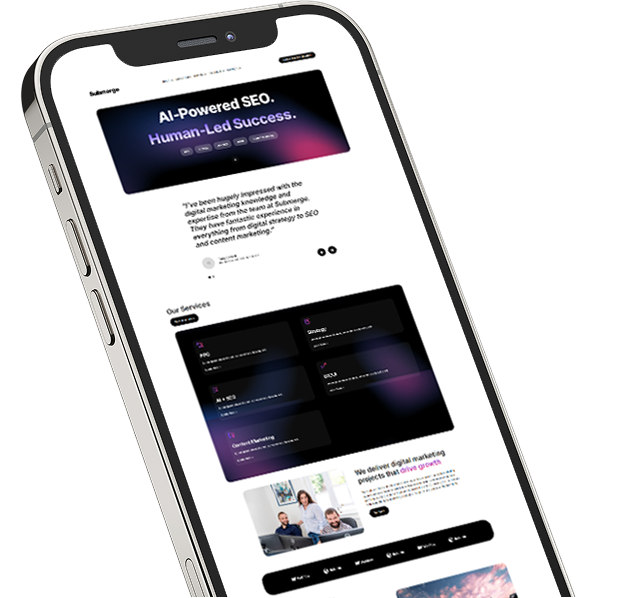
Digital marketingstrategy
Create a clearer path to growth.
Many organisations are active across multiple marketing channels without a clear strategic framework connecting activity to business outcomes. We help leadership teams develop detailed, commercially grounded digital marketing strategies that align audiences, channels, messaging, measurement and operational priorities around measurable growth.

Stay ahead of the pack
Digital marketing strategy
Marketing activity without strategy creates noise.
Many businesses are producing campaigns, content, reporting and channel activity continuously – but without a fully connected strategic framework underneath it all.
Channels are often managed separately. Teams optimise short-term performance while broader positioning drifts. Reporting focuses on isolated metrics rather than commercial outcomes. Internal stakeholders may have different assumptions about audiences, priorities, messaging or growth objectives.
This creates fragmentation across marketing and operational decision-making.
A business may generate traffic without building authority. Paid campaigns may drive leads without improving long-term acquisition efficiency. Content may be created without a clear role in the customer journey. Marketing teams may struggle to prioritise activity because objectives and KPIs are not clearly aligned.
Submerge develops digital marketing strategies that connect visibility, demand generation, measurement and commercial growth into a coherent framework.
We combine market analysis, audience research, search intelligence, content planning, channel strategy, conversion analysis, funnel modelling, KPI development and performance forecasting to help organisations make more confident strategic decisions.
The process is both external and internal.
It considers:
- market conditions
- competitive pressure
- audience behaviour
- operational capability
- reporting maturity
- channel performance
- conversion efficiency
- resource constraints
- and long-term commercial objectives.
The result is a strategy designed not just to generate activity – but to create alignment, focus and measurable growth across the organisation.

SEMrush Agency Partner
We’re a fully Certified SEMrush Agency Partner – advanced search intelligence supporting digital marketing strategies, with clear insights and market-leading AI data.
WP Engine Agency Partner
We’re a Certified WP Engine Agency Partner – performance-focused WordPress expertise supporting technically resilient, AI-readable websites.

Cyber Essentials Certified
We’re Cyber Essentials Certified – Security-conscious technical delivery aligned with recognised UK cybersecurity standards.






Trusted by brands including






Digital marketing strategy experts
Strategic planning
Digital strategy should provide more than a collection of marketing recommendations.
We help organisations build structured growth strategies that align market opportunity, audience demand, positioning, acquisition channels, content ecosystems, reporting frameworks and operational priorities into a cohesive long-term direction.
This includes evaluating:
- current market position
- visibility maturity
- competitive landscape
- acquisition performance
- internal capability
- reporting structures
- funnel performance
- growth constraints
- and commercial objectives.
Our strategies are designed to support both executive decision-making and practical delivery planning across marketing teams and operational stakeholders.
Strategic growth planning
Marketing maturity assessment
Competitive positioning analysis
Commercial roadmap development

Market & audience analysis
Marketing strategies are only effective when grounded in genuine market understanding.
We analyse competitors, search demand, audience behaviour, digital visibility, engagement patterns and conversion journeys to understand how customers discover, evaluate and trust brands across modern digital ecosystems.
This research helps organisations identify:
- where demand exists
- which audiences matter most
- how competitors acquire visibility
- where positioning opportunities exist
- and how behaviour differs across channels and stages of the journey.
Audience and market analysis also helps leadership teams challenge internal assumptions that may no longer reflect how customers behave today.
Audience behaviour analysis
Search demand research
Competitor visibility reviews
Positioning opportunity analysis

Channel & funnel modelling
Many organisations understand channel performance individually but struggle to connect channels into a broader acquisition and conversion model.
We map how audiences move through visibility, engagement, consideration and conversion stages across search, paid media, social, email, content and AI-driven discovery environments. This helps businesses understand how channels interact and where investment creates the greatest strategic impact.
We also build funnel and financial models designed around measurable outcomes. This may include acquisition forecasting, conversion modelling, channel contribution analysis, revenue projections, customer value analysis and KPI alignment across different funnel stages.
This creates a clearer commercial framework for prioritisation, investment and long-term optimisation.
Funnel & journey modelling
Channel contribution analysis
Revenue & acquisition forecasting
KPI & conversion planning

Measurement & optimisation
Strategies become significantly less valuable when there is no framework for measuring execution and performance.
We help businesses define the KPIs, reporting structures, attribution frameworks and optimisation processes required to support long-term strategic delivery. This includes aligning reporting across teams, clarifying measurement governance and ensuring stakeholders use the same performance definitions.
Measurement also increasingly needs to account for fragmented customer journeys and evolving AI-driven discovery behaviour. Organisations need reporting frameworks that connect visibility, engagement, conversion and commercial impact together rather than evaluating channels in isolation.
The aim is to create strategies that remain operationally measurable and commercially accountable over time.
KPI framework development
Reporting & attribution planning
Performance governance
Strategic optimisation frameworks


Strategy must account for fragmented discovery.
Digital marketing environments are becoming more complex, interconnected and harder to predict.
Search behaviour is shifting through AI-powered discovery, conversational interfaces and recommendation systems. Audiences move fluidly between platforms, communities and channels before converting, while attribution pathways are becoming less linear and harder to measure.
This means modern marketing strategy requires broader systems thinking. Organisations increasingly need strategies that connect visibility, authority, channels, reporting and delivery rather than treating marketing disciplines independently.
Start with a digital marketing strategy review
Understand how effectively your current marketing activity aligns with growth goals, audience behaviour and commercial priorities.
We assess market positioning, audience strategy, channel performance, content ecosystems and funnel performance. We ensure KPI alignment, reporting maturity and unearth strategic growth opportunities.
Strategic visibility success stories

Opportunity Green
Learn how Submerge redesigned and developed Opportunity Green's new WordPress website to support tackling climate change.

Bill Wyman
Explore our web design and content marketing work with Bill Wyman, former bass player with the Rolling Stones. Full site design and build.

Ascentor
Discover our work with Ascentor. Learn how our web development delivered impressive results, driving Ascentor's online growth and success.

Orion Registrar, Inc.
Read our web development and migration case study detailing how Submerge transformed Orion Registrar's website with a focus on SEO.

ISO 9001
Building global search visibility for a certification leader – 312% organic traffic growth and 400% CTR boost in six months.

Laithwaites
Learn how Submerge worked with Laithwaites UK team boosting SEO, content strategy, and performance monitoring for success.
The best marketing strategies create organisational alignment.
Many marketing plans focus heavily on channels and campaigns while overlooking the wider systems influencing growth. Audience behaviour, operational capability, reporting maturity, positioning, funnel performance and stakeholder alignment all shape whether strategy succeeds over time.
Effective strategy connects these elements together. It creates a clearer understanding of how visibility becomes engagement, how engagement becomes demand and how marketing activity contributes to measurable commercial outcomes across the business.
138x
The amount of traffic Google get more than ChatGPT.
61%
The drop in organic CTR when AI overviews appear.
47%
Of companies don’t yet have a defined digital marketing strategy.
$1.5tr
The estimated value of the global digital advertising and marketing market in 2030.

“I’ve been hugely impressed with the digital marketing knowledge and expertise from the team at Submerge. They have fantastic experience in everything from digital strategy to SEO and content marketing.”
Tracy Seward
Director of Marketing and Content, Praxis42
Say hello to Submerge

Matthew Bath

Lynn Wright

Marc Bodger

Aimee Lashko-Sayers

Lara Palamoudian

Nicole Percival

Jesse Hopkins
Strategic expertise built around measurable growthBook a consultation
Discover our latest guides, advice and insights
for digital marketing strategy

0 Comments22 Minutes
SEO copywriting checklist for in-house editors
Improve your in-house content with a practical SEO copywriting checklist that improves clarity, search visibility and…

0 Comments17 Minutes
Your guide to the new Google search bar in 2026
Google underwent a major update to keep up with changing search behaviour. Learn how this could impact your business and…

0 Comments17 Minutes
What Google’s new AI version of search means for your business’s visibility
Google Search is changing to better fit its users' changing needs and expectations. Learn how this change will impact your…
Digital marketing strategy FAQs
A digital marketing strategy is a structured framework that defines how an organisation uses digital channels, content, messaging, reporting and customer journeys to achieve commercial objectives.
A mature strategy typically combines market analysis, audience insight, positioning, channel planning, content strategy, acquisition modelling, KPI development and measurement frameworks into a connected long-term plan. The objective is not simply to increase marketing activity, but to align visibility, engagement and conversion efforts around measurable business outcomes.
A decent strategy also considers operational capability and reporting maturity. Even well-designed channel plans can fail if teams, processes, measurement systems or stakeholder alignment are not properly addressed during strategic planning.
Related expertise:
- Strategic planning
- Audience & channel strategy
- KPI framework development
Many organisations focus heavily on execution while lacking a connected strategic framework underneath day-to-day activity.
Channels are often managed independently, reporting structures may be inconsistent, and marketing priorities can shift reactively in response to short-term performance pressures. Teams may also operate with conflicting assumptions around audiences, positioning and KPIs or growth goals.
This fragmentation makes prioritisation difficult. Marketing activities may generate visibility or engagement without meaningfully contributing to broader commercial objectives. A clearer strategy helps organisations align channels, messaging, reporting and operational delivery around shared priorities.
Related expertise:
- Strategic growth planning
- Operational alignment
- Measurement strategy
The exact structure varies depending on the organisation, but most strategies should include:
- market and competitor analysis
- audience insight
- positioning and messaging
- channel strategy
- content planning
- acquisition modelling
- KPI frameworks
- attribution and reporting
- operational considerations
- optimisation planning
For many businesses, strategic clarity also requires understanding how digital activity contributes to wider commercial outcomes such as lead generation, customer acquisition, retention, revenue growth and long-term market positioning.
Related expertise:
- Funnel modelling
- Market analysis
- Reporting & attribution planning
Audience research helps businesses make decisions based on behavioural evidence rather than internal assumptions.
Understanding how customers search, compare, engage and convert across channels provides clearer insight into which messaging, platforms and acquisition strategies are most likely to influence decision-making. Audience behaviour also changes over time as platforms, expectations and discovery patterns evolve.
Research-led strategy helps organisations prioritise investment more effectively while improving alignment between content, channels, conversion pathways and customer needs.
Related expertise:
- Audience behaviour analysis
- Journey mapping
- Search demand research
Funnel modelling examines how audiences move from awareness through to engagement, conversion and retention across digital journeys.
This includes analysing:
- acquisition pathways
- conversion rates
- assisted touchpoints
- drop-off behaviour
- lead quality
- customer value
- revenue contribution
- and long-term growth efficiency
Financial and funnel modelling help organisations forecast growth scenarios, prioritise investments and identify potential performance bottlenecks that may limit acquisition or conversion outcomes.
Related expertise:
- Revenue forecasting
- Conversion analysis
- Attribution modelling
KPIs help organisations measure whether a strategy is creating meaningful progress toward business goals.
Without agreed KPIs, marketing teams often focus on disconnected activity metrics that provide limited visibility into commercial performance. A strategy should define which outcomes matter, how they will be measured and how reporting will support ongoing optimisation and accountability.
KPIs may include visibility growth, lead generation, conversion efficiency, customer acquisition cost, ROAS, assisted conversions, customer value or revenue contribution depending on the organisation’s objectives.
Related expertise:
- KPI framework development
- Reporting strategy
- Performance measurement
AI is reshaping how audiences discover information, evaluate brands and move through digital journeys.
Search behaviour is becoming more fragmented across AI-generated answers, conversational interfaces and recommendation systems. Content strategies increasingly need to account for semantic discoverability, structured information and broader authority signals beyond traditional keyword targeting alone.
AI also affects measurement, attribution and customer expectations. Organisations therefore increasingly need strategies that connect search, AI visibility, content, reporting and channel behaviour into broader discoverability frameworks.
Related expertise:
- Search & AI strategy
- AI visibility planning
- Semantic content strategy
Strategies should evolve continuously as market conditions, customer behaviour and digital ecosystems change.
Most organisations benefit from structured quarterly or biannual strategic reviews alongside ongoing monitoring of performance, market movement and acquisition trends. Strategies that remain static for long periods often become disconnected from audience behaviour and competitive realities.
Review cycles also help businesses adapt to emerging technologies, changing platform dynamics and shifts in commercial priorities over time.
Related expertise:
- Strategic reporting
- Market intelligence
- Ongoing optimisation planning
Yes. One of the most valuable outcomes of strategic planning is often internal alignment.
A clear strategy helps leadership teams, marketing departments, operational stakeholders and commercial teams work from the same priorities, KPIs and growth assumptions. This reduces fragmentation across reporting, channel management and decision-making.
When organisations align around shared goals, clearer measurement frameworks and agreed strategic direction, execution tends to become more focused, efficient and commercially accountable.
Related expertise:
- Stakeholder alignment
- KPI governance
- Strategic reporting frameworks
If you’re not visible
nothing else matters.
Let’s understand where you stand today – and where the opportunities are.
Get in touch and let’s chat about your project.